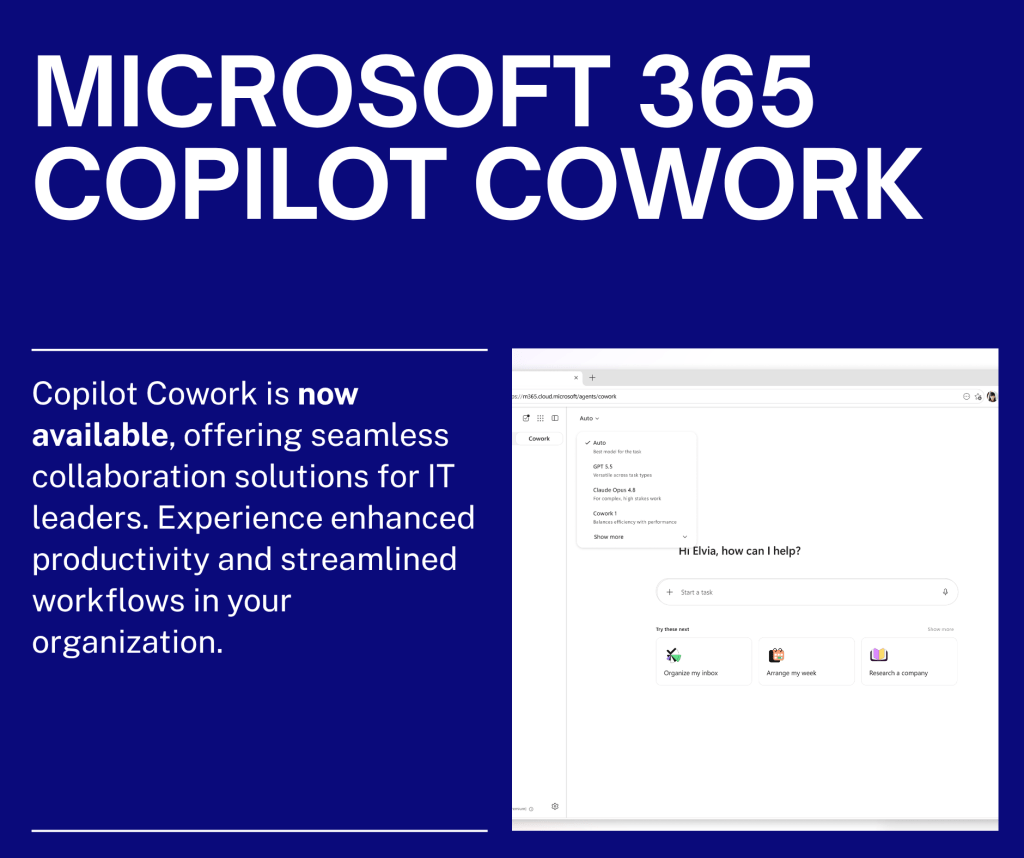
Copilot Cowork just went generally available — and the governance architecture Microsoft shipped alongside it tells you more about where enterprise AI is going than the feature list does.
🚀 What just shipped
Charles Lamanna, Microsoft’s EVP for Copilot, Agents, and Platform, announced the global general availability of Copilot Cowork on June 16, 2026. Three months of Frontier preview generated remarkable numbers: over half of the Fortune 500 adopted it, alongside enterprise names like Accenture, Avanade, Capital Group, Koch Industries, Zurich Insurance, and Ooredoo Qatar. Microsoft calls it the fastest growing feature in the history of its Frontier program — with user satisfaction scores among the highest of any Copilot or agent experience shipped to date.
The key distinction that matters for enterprise IT: Copilot Cowork is not an upgraded chat experience. It is an agentic system designed for complex, long-running, multi-tool tasks — the kind that previously required a team, a week, and careful manual oversight. You define the work; Cowork runs it end-to-end in the cloud (tasks keep running when your laptop is off) and returns a completed result. The Frontier examples are instructive: one team compared nearly 4,000 files across two product versions in the time it would have taken to set up the comparison manually. A sales lead turned a stalled pipeline review — typically a week of manual work — into a single morning task, with specific follow-up notes per at-risk account.
💰 The Copilot Credits cost model: what IT leaders actually need to know
Usage-based billing for agentic AI is a new discipline for most IT organizations, and it has been the most frequent topic in my conversations with CIOs over the past few months. Microsoft’s published framework is straightforward once you break it down.
Copilot Cowork requires an active Microsoft 365 Copilot USL — the standard per-user monthly subscription that already covers Copilot Chat, Copilot in Word/Excel/PowerPoint/Outlook/Teams, Researcher, Analyst, and Agent Builder. Cowork usage is then billed separately via Copilot Credits, calculated from four cost drivers: model use, context retrieval, tool calls, and runtime. Two payment options: PayGo at $0.01 per credit, or P3 (pre-committed volume at a discount).
Microsoft has modeled three task archetypes to support budget planning:
- Light tasks: limited sources, minimal reasoning, one output or fewer — quick lookups, short summaries
- Medium tasks: multiple sources, structured reasoning, two or more outputs — comparative analysis, structured reports
- Heavy tasks: broad aggregation, deep reasoning, many outputs — full pipeline reviews, multi-document audits
The published cost estimator spreadsheet (baseline: Anthropic Opus 4.8) lets you model cost by persona mix and task distribution. One data point worth citing from Microsoft’s internal testing — 125 runs across 12 light/medium/heavy prompts: Copilot Cowork averaged 30–40% cheaper per prompt than Claude Cowork with the M365 connector on equivalent workloads.
🔒 Enterprise security: the controls that matter to CIOs
For enterprise security teams, the compliance posture is as critical as the capabilities. Copilot Cowork operates entirely within the Microsoft 365 trust boundary — prompts, responses, and generated artifacts flow through your existing M365 compliance controls, with sensitivity labels inherited and displayed end-to-end. At GA, the covered surface includes audit log, Data Security Posture Management (DSPM), eDiscovery, and Communication Compliance. Insider Risk Management, DLP, and Data Lifecycle Management are on the near-term roadmap.
Three governance features I consider non-negotiable for any enterprise rollout:
- Off by default: admins explicitly enable Cowork in their tenant and control who gets access
- Spending limits at three levels: tenant, group, and individual user — with customizable usage alerts
- User credit requests: when a user needs additional credits to complete a task, they can request them from inside Cowork — keeping finance visibility intact
🤖 Models, plugins, and the Cowork 1 signal
At GA, Copilot Cowork runs on Anthropic’s Opus 4.8 and Sonnet 4.6. GPT 5.5 is available in Frontier. The more significant near-term development is Cowork 1 — Microsoft’s own fine-tuned model, post-trained specifically for Cowork task patterns at substantially lower cost, with model bias explicitly addressed. This is Microsoft’s clearest signal yet that they intend to own the full stack, not just the orchestration layer.
On the ecosystem side, nine partner plugins are live today: Enosix, Harvey, LSEG, Miro, monday.com, Moodys, Morningstar, S&P Global Energy, and TeamsMaestro. Eight more are coming (Adobe, Atlassian, Box, Canva, CB Insights, Databricks, MoneyForward, Templafy), alongside Dynamics 365 Sales, Customer Service, and ERP apps. Browser use via a local Edge instance — governed by your enterprise Edge policies — is already available in Frontier.
📋 Five actions for IT leaders this week
- Configure spending controls before enabling Cowork: set tenant, group, and user-level caps now — billing starts today. Frontier tenants with active users have a grace period until July 1, 2026
- Run Microsoft’s cost estimator: the published spreadsheet is worth 30 minutes before any budget conversation with your CFO
- Identify your first high-ROI use cases: document comparison, pipeline review, automated reporting — start with repetitive, high-value tasks that currently require manual coordination
- Brief your compliance and legal teams: Cowork prompts and outputs are governed by existing M365 policies, but your teams need to understand what Cowork can produce, store, and surface in eDiscovery
- Plan for Cowork 1: when Microsoft’s fine-tuned model launches, cost per standard task should drop significantly — factor that into your long-term AI cost modelling
The real story of this GA announcement is not the feature list — it is that Microsoft has shipped enterprise AI governance tooling at the same pace as enterprise AI capabilities. That is not the default in this market. Whether or not Copilot Cowork becomes a core part of your IT strategy, the governance framework it introduces is worth understanding — because the usage-based agentic AI model is coming to every platform you run.
Sources: Microsoft 365 Blog — Charles Lamanna, June 16, 2026, Microsoft Learn — Copilot Credits and cost management, Microsoft Adoption — Copilot Cowork
 Sylvain Jacquemard — CIO, Copilot M365 & Microsoft 365 Expert
Leave a comment